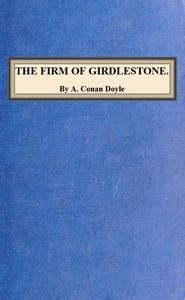
The Firm of Girdlestone — Background and Themes

(2 User reviews)   647
Doyle, Arthur Conan, 1859-1930 Project Gutenberg 2004 Not confirmed
Africa -- Fiction; Businessmen -- Fiction; Criminals -- England -- Fiction; Crime -- England -- Fiction Readers of public-domain and historical texts
Project Gutenberg digital edition en

Edition facts

Words 141,837
Reading time 617 min
Text sections 17

Before opening The Firm of Girdlestone — Background and Themes, the edition data offers a quick orientation: 141,837 words, 10 hr 17 min estimated reading time, and 17 detected text sections.

The text analysis averages about 16.0 words per sentence, while the detected sections provide another way to judge how the source is divided.

Project Gutenberg metadata also associates the work with “Africa -- Fiction,” connecting these edition facts with the source record’s subject description.

Doyle's early novel traces a merchant family's moral decay through precise shifts in narrative pace and voice, from brisk commercial realism to tense psychological interiority, as the firm's survival hinges on a forced marriage and African diamond speculation.
Share
Editorial Edition Score 4.8/5

Calculated from edition completeness, EPUB availability, text structure and catalogue metadata. Not a user rating.

How this score is calculated
  • Description quality20 pts
  • Title & short description10 pts
  • Source metadata20 pts
  • Text length15 pts
  • Chapters / structure15 pts
  • EPUB file integrity20 pts

Total of 100 points, scaled to a 2.5-5.0 range. Editions with an empty description or a missing EPUB file are not scored.

Edition quality

Read the Text

MR. JOHN HARSTON KEEPS AN APPOINTMENT.

The approach to the offices of Girdlestone and Co. was not a very dignified one, nor would the uninitiated who traversed it form any conception of the commercial prosperity of the firm in question. Close to the corner of a broad and busy street, within a couple of hundred yards of Fenchurch Street Station, a narrow doorway opens into a long whitewashed passage. On one side of this is a brass plate with the inscription "Girdlestone and Co., African Merchants," and above it a curious hieroglyphic supposed to represent a human hand in the act of pointing. Following the guidance of this somewhat ghostly emblem, the wayfarer finds himself in a small square yard surrounded by doors, upon one of which the name of the firm reappears in large white letters, with the word "Push" printed beneath it. If he follows this laconic invitation he will make his way into a long, low apartment, which is the counting-house of the African traders.

On the afternoon of which we speak things were quiet at the offices. The line of pigeon-holes in the wire curtain was deserted by the public, though the linoleum-covered floor bore abundant traces of a busy morning. Misty London light shone hazily through the glazed windows and cast dark shadows in the corners. On a high perch in the background a weary-faced, elderly man, with muttering lips and tapping fingers, cast up endless lines of figures. Beneath him, in front of two long shining mahogany desks, half a score of young men, with bent heads and stooping shoulders, appeared to be riding furiously, neck and neck, in the race of life. Any _habitue_ of a London office might have deduced from their relentless energy and incorruptible diligence that they were under the eyes of some member of the firm.

The member in question was a broad-shouldered, bull-necked young man, who leaned against the marble mantel-piece, turning over the pages of an almanac, and taking from time to time a stealthy peep over the top of it at the toilers around him. Command was imprinted in every line of his strong, square-set face and erect, powerful frame. Above the medium size, with a vast spread of shoulder, a broad aggressive jaw, and bright bold glance, his whole pose and expression spoke of resolution pushed to the verge of obstinacy. There was something classical in the regular olive-tinted features and black, crisp, curling hair fitting tightly to the well-rounded head. Yet, though classical, there was an absence of spirituality. It was rather the profile of one of those Roman emperors, splendid in its animal strength, but lacking those subtle softnesses of eye and mouth which speak of an inner life. The heavy gold chain across the waistcoat and the bright stone which blazed upon the finger were the natural complement of the sensuous lip and curving chin. Such was Ezra, only child of John Girdlestone, and heir to the whole of his vast business. Little wonder that those who had an eye to the future bent over their ledgers and worked with a vigour calculated to attract the attention of the junior partner, and to impress him with a due sense of their enthusiastic regard for the interests of the firm.

It was speedily apparent, however, that the young gentleman's estimate of their services was not entirely based upon their present performance. With his eyes still fixed upon the almanac and a sardonic smile upon his dark face, he uttered a single word--

A flaxen-haired clerk, perched at the further end of the high glistening desk, gave a violent start, and looked up with a scared face.

"Well, Parker, who won?" asked the junior partner.

"Won, sir!" the youth stammered.

"Yes, who won?" repeated his employer.

"I hardly understand you, sir," the clerk said, growing very red and confused.

"Oh yes, you do, Parker," young Girdlestone remarked, tapping his almanac sharply with the paper-knife. "You were playing odd man out with Robson and Perkins when I came in from lunch. As I presume you were at it all the time I was away, I have a natural curiosity to know who won."

The three unhappy clerks fixed their eyes upon their ledgers to avoid the sarcastic gaze of their employer. He went on in the same quiet tones--

"You gentlemen draw about thirty shillings a week from the firm. I believe I am right in my figures, Mr. Gilray?" addressing the senior clerk seated at the high solitary desk apart from the others. "Yes, I thought so. Now, odd man out is, no doubt, a very harmless and fascinating game, but you can hardly expect us to encourage it so far as to pay so much an hour for the privilege of having it played in our counting-house. I shall therefore recommend my father to deduct five shillings from the sum which each of you will receive upon Saturday. That will cover the time which you have devoted to your own amusements during the week."

He paused, and the three culprits were beginning to cool down and congratulate themselves, when he began again.

"You will see, Mr. Gilray, that this deduction is made," he said, "and at the same time I beg that you will deduct ten shillings from your own salary, since, as senior clerk, the responsibility of keeping order in this room in the absence of your employers rests with you, and you appear to have neglected it. I trust you will look to this, Mr. Gilray."

"Yes, sir," the senior clerk answered meekly. He was an elderly man with a large family, and the lost ten shillings would make a difference to the Sunday dinner. There was nothing for it but to bow to the inevitable, and his little pinched face assumed an expression of gentle resignation. How to keep his ten young subordinates in order, however, was a problem which vexed him sorely.

The junior partner was silent, and the remaining clerks were working uneasily, not exactly knowing whether they might not presently be included in the indictment. Their fears were terminated, however, by the sharp sound of a table-gong and the appearance of a boy with the announcement that Mr. Girdlestone would like a moment's conversation with Mr. Ezra. The latter gave a keen glance at his subjects and withdrew into the back office, a disappearance which was hailed by ten pens being thrown into the air and deftly caught again, while as many derisive and triumphant young men mocked at the imploring efforts of old Gilray in the interests of law and order.

The sanctum of Mr. John Girdlestone was approached by two doors, one of oak with ground-glass panels, and the other covered with green baize. The room itself was small, but lofty, and the walls were ornamented by numerous sections of ships stuck upon long flat boards, very much as the remains of fossil fish are exhibited in museums, together with maps, charts, photographs, and lists of sailings innumerable. Above the fire-place was a large water-colour painting of the barque _Belinda_ as she appeared when on a reef to the north of Cape Palmas. An inscription beneath this work of art announced that it had been painted by the second officer and presented by him to the head of the firm. It was generally rumoured that the merchants had lost heavily over this disaster, and there were some who quoted it as an instance of Girdlestone's habitual strength of mind that he should decorate his wall with so melancholy a souvenir. This view of the matter did not appear to commend itself to a flippant member of Lloyd's agency, who contrived to intimate, by a dexterous use of his left eyelid and right forefinger, that the vessel may not have been so much under-insured, nor the loss to the firm so enormous as was commonly reported.

John Girdlestone, as he sat at his square office-table waiting for his son, was undeniably a remarkable-looking man. For good or for evil no weak character lay beneath that hard angular face, with the strongly marked features and deep-set eyes. He was clean shaven, save for an iron-grey fringe of ragged whisker under each ear, which blended with the grizzled hair above. So self-contained, hard-set, and immutable was his expression that it was impossible to read anything from it except sternness and resolution, qualities which are as likely to be associated with the highest natures as with the most dangerous. It may have been on account of this ambiguity of expression that the world's estimate of the old merchant was a very varying one. He was known to be a fanatic in religion, a purist in morals, and a man of the strictest commercial integrity. Yet there were some few who looked askance at him, and none, save one, who could apply the word "friend" to him.

He rose and stood with his back to the fire-place as his son entered. He was so tall that he towered above the younger man, but the latter's square and compact frame made him, apart from the difference of age, the stronger man.

The young man had dropped the air of sarcasm which he found was most effective with the clerks, and had resumed his natural manner, which was harsh and brusque.

"What's up!" he asked, dropping back into a chair, and jingling the loose coins in his trouser pockets.

"I have had news of the _Black Eagle_," his father answered. "She is reported from Madeira."

"Ah!" cried the junior partner eagerly. "What luck?"

"She is full, or nearly so, according to Captain Hamilton Miggs' report."

"I wonder Miggs was able to send a report at all, and I wonder still more that you should put any faith in it," his son said impatiently. "The fellow is never sober."

"Miggs is a good seaman, and popular on the coast. He may indulge at times, but we all have our failings. Here is the list as vouched for by our agent. 'Six hundred barrels of palm oil'--"

"Oil is down to-day," the other interrupted.

"It will rise before the _Black Eagle_ arrives," the merchant rejoined confidently. "Then he has palm nuts in bulk, gum, ebony, skins, cochineal, and ivory."

The young man gave a whistle of satisfaction. "Not bad for old Miggs!" he said. "Ivory is at a fancy figure."

"We are sorely in need of a few good voyages," Girdlestone remarked, "for things have been very slack of late. There is one very sad piece of intelligence here which takes away the satisfaction which we might otherwise feel. Three of the crew have died of fever. He does not mention the names."

"The devil!" said Ezra. "We know very well what that means. Three women, each with an armful of brats, besieging the office and clamouring for a pension. Why are seamen such improvident dogs?"

His father held up his white hand deprecatingly. "I wish," he said, "that you would treat these subjects with more reverence. What could be sadder than that the bread-winner of a family should be cut off? It has grieved me more than I can tell."

"Then you intend to pension the wives?" Ezra said, with a sly smile.

"By no means," his father returned with decision. "Girdlestone and Co. are not an insurance office. The labourer is worthy of his hire, but when his work in this world is over, his family must fall back upon what has been saved by his industry and thrift. It would be a dangerous precedent for us to allow pensions to the wives of these sailors, for it would deprive the others of all motive for laying their money by, and would indirectly encourage vice and dissipation."

Ezra laughed, and continued to rattle his silver and keys.

"It is not upon this matter that I desired to speak to you," Girdlestone continued. "It has, however, always been my practice to prefer matters of business to private affairs, however pressing. John Harston is said to be dying, and he has sent a message to me saying that he wishes to see me. It is inconvenient for me to leave the office, but I feel that it is my Christian duty to obey such a summons. I wish you, therefore, to look after things until I return."

"I can hardly believe that the news is true," Ezra said, in astonishment. "There must be some mistake. Why, I spoke to him on 'Change last Monday."

"It is very sudden," his father answered, taking his broad-brimmed hat from a peg. "There is no doubt about the fact, however. The doctor says that there is very little hope that he will survive until evening. It is a case of malignant typhoid."

"You are very old friends?" Ezra remarked, looking thoughtfully at his father.

"I have known him since we were boys together," the other replied, with a slight dry cough, which was the highest note of his limited emotional gamut. "Your mother, Ezra, died upon the very day that Harston's wife gave birth to this daughter of his, seventeen years ago. Mrs. Harston only survived a few days. I have heard him say that, perhaps, we should also go together. We are in the hands of a higher Power, however, and it seems that one shall be taken and another left."

"How will the money go if the doctors are right?" Ezra asked keenly.

"Every penny to the girl. She will be an heiress. There are no other relations that I know of, except the Dimsdales, and they have a fair fortune of their own. But I must go."

"By the way, malignant typhoid is very catching, is it not?"

"So they say," the merchant said quietly, and strode off through the counting-house.

Ezra Girdlestone remained behind, stretching his legs In front of the empty grate. "The governor is a hard nail," he soliloquized, as he stared down at the shining steel bars. "Depend upon it, though, he feels this more than he shows. Why, it's the only friend he ever had in the world--or ever will have, in all probability. However, it's no business of mine," with which comforting reflection he began to whistle as he turned over the pages of the private day-book of the firm.

It is possible that his son's surmise was right, and that the gaunt, unemotional African merchant felt an unwonted heartache as he hailed a hansom and drove out to his friend's house at Fulham. He and Harston had been charity schoolboys together, had roughed it together, risen together, and prospered together. When John Girdlestone was a raw-boned lad and Harston a chubby-faced urchin, the latter had come to look upon the other as his champion and guide. There are some minds which are parasitic in their nature. Alone they have little vitality, but they love to settle upon some stronger intellect, from which they may borrow their emotions and conclusions at second-hand. A strong, vigorous brain collects around it in time many others, whose mental processes are a feeble imitation of its own. Thus it came to pass that, as the years rolled on, Harston learned to lean more and more upon his old school-fellow, grafting many of his stern peculiarities upon his own simple vacuous nature, until he became a strange parody of the original. To him Girdlestone was the ideal man, Girdlestone's ways the correct ways, and Girdlestone's opinions the weightiest of all opinions. Forty years of this undeviating fidelity must, however he might conceal it, have made an impression upon the feelings of the elder man.

Harston, by incessant attention to business and extreme parsimony, had succeeded in founding an export trading concern. In this he had followed the example of his friend. There was no fear of their interests ever coming into collision, as his operations were confined to the Mediterranean. The firm grew and prospered, until Harston began to be looked upon as a warm man in the City circles. His only child was Kate, a girl of seventeen. There were no other near relatives, save Dr. Dimsdale, a prosperous West-end physician. No wonder that Ezra Girdlestone's active business mind, and perhaps that of his father too, should speculate as to the disposal of the fortune of the dying man.

Girdlestone pushed open the iron gate and strode down the gravel walk which led to his friend's house. A bright autumn sun shining out of a cloudless heaven bathed the green lawn and the many-coloured flower-beds in its golden light. The air, the leaves, the birds, all spoke of life. It was hard to think that death was closing its grip upon him who owned them all. A plump little gentleman in black was just descending the steps.

"Well, doctor," the merchant asked, "how is your patient?"

"You've not come with the intention of seeing him, have you?" the doctor asked, glancing up with some curiosity at the grey face and overhanging eyebrows of the merchant.

"Yes, I am going up to him now."

"It is a most virulent case of typhoid. He may die in an hour or he may live until nightfall, but nothing can save him. He will hardly recognize you, I fear, and you can do him no good. It is most infectious, and you are incurring a needless danger. I should strongly recommend you not to go."

"Why, you've only just come down from him yourself, doctor."

"Ah, I'm there in the way of duty."

"So am I," said the visitor decisively, and passing up the stone steps of the entrance strode into the hall. There was a large sitting-room upon the ground floor, through the open door of which the visitor saw a sight which arrested him for a moment. A young girl was sitting in a recess near the window, with her lithe, supple figure bent forward, and her hands clasped at the back of her head, while her elbows rested upon a small table in front of her. Her superb brown hair fell in a thick wave on either side over her white round arms, and the graceful curve of her beautiful neck might have furnished a sculptor with a study for a mourning Madonna. The doctor had just broken his sad tidings to her, and she was still in the first paroxysm of her grief--a grief too acute, as was evident even to the unsentimental mind of the merchant, to allow of any attempt at consolation. A greyhound appeared to think differently, for he had placed his fore-paws upon his young mistress's lap, and was attempting to thrust his lean muzzle between her arms and to lick her face in token of canine sympathy. The merchant paused irresolutely for a moment, and then ascending the broad staircase he pushed open the door of Harston's room and entered.

The blinds were drawn down and the chamber was very dark. A pungent whiff of disinfectants issued from it, mingled with the dank, heavy smell of disease. The bed was in a far corner. Without seeing him, Girdlestone could hear the fast laboured breathing of the invalid. A trimly dressed nurse who had been sitting by the bedside rose, and, recognizing the visitor, whispered a few words to him and left the room. He pulled the cord of the Venetian blind so as to admit a few rays of daylight. The great chamber looked dreary and bare, as carpet and hangings had been removed to lessen the chance of future infection. John Girdlestone stepped softly across to the bedside and sat down by his dying friend.

The sufferer was lying on his back, apparently unconscious of all around him. His glazed eyes were turned upwards towards the ceiling, and his parched lips were parted, while the breath came in quick, spasmodic gasps. Even the unskilled eye of the merchant could tell that the angel of death was hovering very near him. With an ungainly attempt at tenderness, which had something pathetic in it, he moistened a sponge and passed it over the sick man's feverish brow. The latter turned his restless head round, and a gleam of recognition and gratitude came into his eyes.

"I knew that you would come," he said.

"Yes. I came the moment that I got your message."

"I am glad that you are here," the sufferer continued with a sigh of relief. From the brightened expression upon his pinched face, it seemed as if, even now in the jaws of death, he leaned upon his old schoolfellow and looked to him for assistance. He put a wasted hand above the counterpane and laid it upon Girdlestone's.

"I wish to speak to you, John," he said. "I am very weak. Can you hear what I say?"

"Give me a spoonful from that bottle. It clears my mind for a time. I have been making my will, John."

The Firm of Girdlestone opens not with a dramatic incident but with a measured description of a commercial office's unassuming approach, establishing a tone of deliberate, almost documentary realism. Doyle's narrative voice quickly proves flexible, moving from the brisk, factual register of business dealings to a more intimate, psychological mode when tracing the inner life of John Girdlestone. The novel's pacing is notably uneven: early chapters proceed with the steady rhythm of Victorian commercial fiction, while later sections accelerate into tense, almost thriller-like sequences involving African ventures and domestic coercion. This variability in tempo is not a flaw but a deliberate structural choice, reflecting the instability of the firm itself.

Commercial Realism and Narrative Rhythm

The novel's opening chapters establish a world governed by ledgers, appointments, and the physical details of London commerce. Doyle lingers on the approach to the offices and the commercial prosperity of the firm, grounding the story in a recognizable, material reality. The prose here is efficient and unadorned, matching the subject matter. Yet even within this realist frame, Doyle introduces variations in pace: a chapter titled Charity à la Mode suggests a satirical quickening, while A Corner in Diamonds implies a more suspenseful, plot-driven rhythm. The early sections thus establish a baseline of measured observation against which later accelerations will register.

The Shift to Psychological Interiority

As the narrative progresses, Doyle increasingly abandons external description for the internal landscape of John Girdlestone. The prose tightens, focusing on the merchant's dogged heart and his repeated mantra, they can't beat me. The narrator's voice becomes more analytical, dissecting Girdlestone's entire conviction of the righteousness of his actions and his blind strength of will and self-conceit. This shift in pace—from outward action to inward obsession—mirrors the character's own retreat from the public sphere into a private world of financial desperation and moral self-justification. The language grows more incisive, even clinical, as Doyle traces the strangest of all the phenomena of a conscience that never troubles its owner.

Acceleration and the Threat of Collapse

The novel's later chapters introduce a marked quickening of tempo. Chapter titles such as The Shadow of Death, A Midnight Cruise, and A Voyage in a Coffin Ship signal a turn toward melodrama and physical danger. The narrative voice becomes more urgent, less reflective, as events crowd in: a chase, a brawl, a journey to the Priory. This acceleration is not merely a change in plot but a deliberate modulation of pace, contrasting with the earlier, more deliberate sections. The final chapter, Winds Up the Thread and Ties Two Knots at the End, explicitly acknowledges the need for resolution, but the preceding rush of incident leaves the reader with a sense of precariousness that matches the firm's own instability.

Voice and the Unreliable Self-Justification

Doyle's handling of narrative voice is particularly subtle in his portrayal of John Girdlestone. The narrator maintains a cool, omniscient distance, yet repeatedly enters the character's consciousness to report his self-justifications without overt condemnation. This technique creates a tension between the reader's judgment and the character's own entire conviction of righteousness. The voice shifts between ironic detachment and sympathetic penetration, never fully endorsing or condemning. This ambiguity is central to the novel's effect, as it forces readers to navigate the gap between Girdlestone's self-perception and the accumulating evidence of his moral failure.

Readers attentive to Doyle's manipulation of pace and voice will find a novel that resists easy categorization. The early chapters reward patience with their detailed social observation; the later ones demand a willingness to follow rapid, sometimes improbable turns of plot. The key is to watch how the narrator's tone shifts with each phase of the story, and how the rhythm of the prose itself becomes a commentary on the firm's precarious existence. This is not a uniformly paced work, but one whose very unevenness is its most telling feature.

That rainy afternoon, the Girdlestone family’s forced marriage and diamond greed stayed with me long after I closed the book. The way their moral decay felt almost quiet, like wet leaves slipping into a gutter, reminded me of something else on my shelf. A softer, busier world, where money and manners tangle just as messily. I picked up Keeping up with Lizzie — Text and Context and found the same unease, dressed in brighter cloth.

Leo Gonzalez
1 month ago

Isabella Green
1 week ago

3.5
3.5 out of 5 (2 User reviews )

Add a Review

Your Rating *
  • ...
    Jessica Clark - 1 month ago
    Arthur Conan Doyle's 'The Firm of Girdlestone' is a gripping Victorian thriller that showcases his masterful storytelling. The intricate plot follows a young man's dangerous entanglement with a ruthless merchant firm, blending suspense, betrayal, and romance. Doyle's vivid characters and atmospheric settings keep the pages turning, and the moral complexities add depth. A must-read for fans of classic mystery and adventure, offering a satisfying, thought-provoking tale.

  • ...
    Rachel Stone - 1 month ago
    While the premise is promising, 'The Firm of Girdlestone' suffers from slow pacing and overlong descriptive passages that hinder the tension. The protagonist is somewhat flat compared to Doyle's other creations, and the villain's motivations feel underexplored. The ending, though conclusive, feels rushed. Hardcore fans may enjoy it, but others might find it a struggle to finish.

  • ...
    Rachel Miller - 3 weeks ago
    An engaging Victorian-era tale with a solid plot and interesting characters. The story unfolds at a steady pace, with plenty of twists. However, some sections felt overly verbose, and the romance subplot was a bit predictable. Despite these minor flaws, the book is a decent read for fans of Conan Doyle's non-Sherlock Holmes works.


Reader reflection

Record your reading impressions

A brief reflection can help important ideas stay with you longer.
Your progress 0 / 10
1

What is your current status with this title?

2

Did this book hold your interest?

3

Would you recommend this book to another reader?

4

What was the reading difficulty like?

Related eBooks