About 574 minutes
The Secret City — Text and Context
Historical Psychological Social Fiction
131,941 recorded words. 0 minutes difference from this book's estimate.
View Gutenberg source #12349
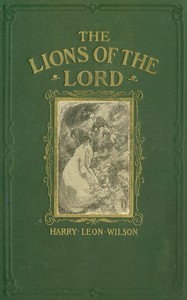
The catalog record for The Lions of the Lord: A Tale of the Old West — Story, Setting & Ideas provides practical reading context through 131,901 words, 9 hr 34 min estimated reading time, and 45 detected text sections.
The text analysis averages about 20.8 words per sentence, while the detected sections provide another way to judge how the source is divided.
Project Gutenberg metadata also associates the work with “Historical fiction,” connecting these edition facts with the source record’s subject description.
Explore this collection
These alternatives are selected using recorded categories and estimated reading time.
About 574 minutes
Historical Psychological Social Fiction
131,941 recorded words. 0 minutes difference from this book's estimate.
View Gutenberg source #12349About 617 minutes
Historical Psychological Social Fiction
141,837 recorded words. 43 minutes difference from this book's estimate.
View Gutenberg source #13152About 528 minutes
Historical Psychological Social Fiction
121,293 recorded words. 46 minutes difference from this book's estimate.
View Gutenberg source #13501Search stored excerpts and compare books → Choose by your preferences →
Choices use stored catalog measurements. Estimates vary with reading speed. A shared category is a catalog label, not a claim that two books have the same argument or literary quality.
Search reads excerpt text stored with this catalog and links to its associated Gutenberg record. The connection is stored in the site database; this tool does not recheck that every excerpt is word-for-word identical to that external record. Excerpt search does not cover every chapter and does not verify historical publication dates.
Catalog snapshot checked: 2026-09-25. Coverage: 97 public books, 97 available source excerpts.
Read the complete public-domain text at its original source.
Read on Project GutenbergThe foreword to Harry Leon Wilson's 1903 novel immediately distinguishes it from formulaic Westerns. Wilson describes seven trails from the frontier, calling the Salt Lake Trail 'the one richest in story' because at its western end 'was woven a romance within a romance.' He claims the actual history was so dramatic that his planned fiction seemed 'clumsy and poor,' so he turned to 'try to tell what had really been.' This framing—asserting that fact outdoes invention—sets up a narrative that, based on the excerpts, centers on a man's spiritual crisis in the desert.
Wilson's foreword promises a story grounded in historical truth, with 'make-believe' only as 'a cement to join the queerly wrought stones of fact.' The catalog subjects list 'Latter Day Saint pioneers' and 'Western stories,' but the excerpts do not explicitly name the Mormon faith or pioneer community. Instead, they depict a lone man wandering in 'scorching sands,' tormented by 'a mass of yellow hair' and haunted by his own 'arrogance of soul.' The foreword mentions 'a drama of human passions, of love and hate, of high faith and low,' but the excerpted passages focus narrowly on a single character's internal torment and a vision of a cross. Readers should note that the excerpts may not represent the broader historical canvas Wilson describes.
The protagonist's journey is less about physical survival than a psychological and spiritual reckoning. He 'knew he had passed sentence of death upon himself, knew he had been led to sin by his own arrogance of soul.' His prayer—'God be merciful to me, a sinner'—is repeated 'over and over,' and he weeps for the first time since a night 'on the river-flat across from Nauvoo.' This reference to Nauvoo, a key Mormon settlement, is the only explicit link to the catalog's pioneer subject. The narrative voice shifts between external description and the character's thoughts, as when 'some new, strange peace had filled him' after his prayer. The excerpts suggest a novel more concerned with inner conflict than with action or community.
The desert setting is rendered with sensory detail: 'the scorching sands,' 'the full glare of the sun,' and the protagonist lying 'with his head on his arm.' Wilson uses the landscape to heighten psychological tension. The protagonist sees 'a mass of light clouds, volatile, changing with opalescent lights,' then a 'miracle of miracles'—a cross in the sky, followed by 'figures about it.' The text leaves open whether this is hallucination, divine vision, or a mirage: 'Some picture was trying to show itself to him.' The foreword's claim that 'the things that are strangest have most of truth' invites readers to interpret this scene as both a realistic symptom of dehydration and a symbolic moment of grace. The excerpts do not reveal the outcome of this vision.
Readers approaching The Lions of the Lord should weigh Wilson's foreword against the actual narrative. The excerpts reveal a novel that may be less a panoramic historical epic than a concentrated study of guilt and redemption. The protagonist's isolation and the desert's symbolic weight suggest a psychological drama, while the Nauvoo reference ties it to Mormon history. Pay attention to how Wilson balances his stated commitment to fact with the interior, visionary episodes that dominate the sampled pages.
I keep thinking about Wilson’s desert wanderer, his pride cracking open against that hallucinated cross. It reminded me, oddly, of how Sanctuary sits with its own quiet brand of reckoning—not the same story, but the same ache of a soul meeting its limits. Sanctuary — Context and Discussion carries that weight gently, like a memory I didn’t expect to revisit.
Create a short personal record of your experience with this book.