1

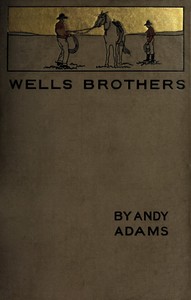
Wells Brothers: The Young Cattle Kings — Reading Notes
22
3
Project Gutenberg
2004
Historical fiction; Western stories; Ranch life -- Fiction
Readers of public-domain and historical texts
Project Gutenberg digital edition
en
Edition facts
Words: 78,147
Reading time: 340 min
Text sections: 7
Source:
Project Gutenberg record #12791
Andy Adams's 1911 Western follows orphaned brothers Joel and Dell Wells as they claim a cattle range on the Kansas plains. The narrative shifts between trail-camp banter and stark winter survival, with precise attention to herd management, weather, and the brothers' evolving voices.
Andy Adams's Wells Brothers: The Young Cattle Kings (1911) opens not with its titular orphans but with a trail crew's roughhorseplay: a scuffle between bunkies Quince Forrest and the horse wrangler, a swapped pistol belt, and a loaded cylinder that nearly costs a life. The accident is a narrative feint—the Wells brothers do not appear until the second chapter—but it establishes the book's texture: a world where danger hides in everyday routines and where men's voices, whether joking or urgent, carry the story. Adams writes with a reporter's ear for dialogue and a cattleman's eye for detail, shifting from the crew's banter to the brothers' spare, determined exchanges once they take over the Beaver Creek range.
Two Voices, One Purpose
Joel and Dell Wells speak differently, and Adams uses that difference to mark their growth. Joel, the elder, is cautious and deliberate: “What's your hurry? I haven't shouted yet. I'm not sure that we're out of the woods.” Dell, younger and more impulsive, urges action: “The winter's over. Listen to the creek talking to itself.” Their dialogue is never expositional; it reveals character through rhythm. Joel's sentences are longer, hedged with conditionals; Dell's are short, declarative, eager. Yet both share a core vocabulary of work—herd, corral, range, cattle, winter—that anchors them to the land. As the story progresses, their voices converge: by the late excerpt, Dell says “It was good fighting, and I feel like shouting,” borrowing Joel's metaphor of combat. The shift is subtle, traceable only in word choice and sentence length, but it suggests a shared resilience forged through months of shared labor.
The Pace of Waiting and Storm
Adams controls narrative tempo by alternating slow, observational passages with sudden crises. In the opening chapter, the morning routine unfolds in leisurely detail: the herd grazing, the men breakfasting, the foreman's languid remark. Then, without transition, the pistol discharges. Later, the brothers' winter management is described through patient cycles—checking cattle, noting weather, mending corrals—until a squall “struck near the middle of the afternoon. It came without warning.” The storm scenes are compressed, urgent, stripped of reflection: “The herd turned its back to the storm, and took up the steady, sullen march of a winter drift.” Between these bursts, Adams lingers on the natural world—the creek talking, the grass refusing to come forth, the crows arriving too early—giving the reader time to feel the weight of waiting. The result is a rhythm that mimics ranch life itself: long stretches of vigilance punctuated by moments of violent action.
Weather as Antagonist and Teacher
Adams treats weather not as backdrop but as a character with agency. The brothers read its signs with the attention of trackers: “the absence of other signs of spring carried a warning that the wintry elements might yet arise and roar like a young lion.” Joel cites a proverb about March coming in like a lamb; Dell hears the creek's thaw as speech. The storms are described in physical, almost tactile terms—a “swirl of soft snow” that envelops horses and riders, a “winter drift” that the cattle follow “sullenly.” But weather also teaches. Joel's caution is vindicated when the late March squall hits; Dell's optimism is checked. The narrative never moralizes, but the pattern is clear: survival depends on reading the sky, not hoping. Adams's prose stays close to the senses—cold, wind, the feel of a horse under saddle—so that the reader, like the brothers, learns to watch for the squall line on the horizon.
Adams's novel rewards attention to its silences: the moments when dialogue stops and the landscape takes over, or when a single detail—a loaded cylinder, a thawing creek—carries the weight of the story. Readers who track the brothers' changing speech, the rhythm of crisis and calm, and the weather's role as both enemy and instructor will find a Western that works by accumulation, not melodrama. The excerpts suggest a book more interested in how its characters endure than in what they achieve.
Reader reflection
What was your reading experience?
Capture what you thought, learned, and would like to remember.
Your progress
0
/
10
2
How did the book work for you overall?
3
Would you encourage someone else to read it?
4
How much effort did this book require?
5
Was the book moving at the right speed?
6
How clearly were the main ideas presented?
7
Did anything about the book feel genuinely new?
8
Would this book work well in a reading group?
9
What did this book teach you most?
10