1

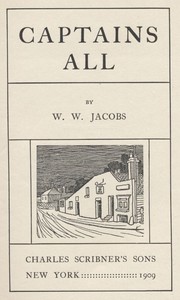
The Nest Egg Captains All, Book 3. — Background and Themes
12
1
Project Gutenberg
2004
Humorous stories, English; England -- Social life and customs -- Fiction; River life -- Fiction
Readers of public-domain and historical texts
Project Gutenberg digital edition
en
Edition facts
Words: 7,440
Reading time: 33 min
Text sections: 1
Source:
Project Gutenberg record #11183
In W.W. Jacobs's comic short story, a night-watchman recounts how a sailor's scheme to retrieve his savings from his fiancée backfires through a series of artful deceptions and ironic reversals.
Editorial Edition Score
4.4/5
★★★★★
★★★★★
Calculated from edition completeness, EPUB availability, text structure and catalogue metadata. Not a user rating.
Edition quality
The night-watchman who narrates this story opens with a wry reflection on artfulness, claiming it 'don't pay always' and that he has 'surprised more than one' by pretending to be stupider than he is. This framing sets up a tale of layered deceit, where the listener is primed to watch for the gap between appearance and reality. The narrative voice is distinctive: colloquial, self-correcting, and laced with comic hesitation, as when the watchman revises his own phrasing three times to describe his feigned stupidity. Jacobs uses this oral storytelling style to create intimacy and suspense, drawing the reader into the watchman's world of dockside wisdom and domestic comedy.
The Watchman's Voice and Self-Presentation
The story is delivered entirely in the night-watchman's vernacular, a working-class London speech full of dropped aitches, double negatives, and rhythmic repetition. His opening remarks about artfulness are a performance in themselves: he pauses, corrects himself, and finally lands on a precise formulation—'More stupid than wot they thought I looked'—as if polishing a joke. This self-conscious narration establishes him as a man who enjoys his own cleverness and wants his audience to appreciate it. He also undercuts his authority by admitting his wife got the better of him, a confession that humanizes him and hints at the story's theme of domestic power. The watchman's voice is the story's engine, and Jacobs sustains it without slipping into caricature, giving each phrase a natural, spoken rhythm.
The Sailor's Dilemma and the Artfulness of Deception
Charlie Tagg, a steady young sailor, has saved seventy-two pounds with his London fiancée Emma Cook for a future shop. But in Sydney he promises marriage to another woman and needs the money back. His problem is practical: how to retrieve the savings without revealing his betrayal. The watchman notes that Charlie's head was 'all in a maze' trying to solve it. Charlie's plan—to borrow a friend's help in pretending to be a bad character—is a classic comic scheme that relies on acting and misdirection. Jacobs presents the dilemma with economy: the sum of money is specific (seventy-two pounds and seventeen-and-six of Emma's own), and the geography (Sydney to Poplar) underscores the distance between Charlie's two lives. The scheme's fragility is evident from the start, as the watchman's framing warns that sudden artfulness rarely succeeds.
The Confrontation Scene and Comic Reversals
The climax unfolds in the Cook family's front parlour, where Jack Bates, Charlie's accomplice, pretends to be a creditor demanding repayment. The dialogue crackles with indignation and misunderstanding. Mrs. Cook and old Cook attack Jack's face, calling it 'low' and 'one o' the worst I ever see,' a running gag that contrasts with Jack's own view that he has 'a very good-'arted face.' Emma, pale and proud, throws the money and Charlie's ring on the table. But then Jack, moved by Emma's dignity, abruptly returns the money to Charlie, declaring it a 'free gift.' This reversal shocks everyone, especially Charlie, who is left 'arf mad with temper' because the gift undermines his plan. Jacobs builds the scene through escalating insults and physical details—the window opened and closed—that heighten the farce.
Dialogue as a Tool of Character and Comedy
Jacobs relies almost entirely on dialogue to advance the plot and reveal character. Each character speaks in a distinct register: the watchman's ruminative, self-amused tone; Charlie's stammering evasions; Emma's clipped dignity; Mrs. Cook's sharp suspicions; old Cook's blustering insults. The comedy emerges from the gap between what characters say and what they mean, and from the rapid-fire exchanges where misunderstandings pile up. For instance, when Jack says he 'only wanted my own,' Mrs. Cook retorts, 'Well, you've got it, and now you can go.' The dialogue also carries the story's moral weight: Emma's quiet defiance and Jack's sudden generosity complicate the simple scheme, suggesting that artfulness can be undone by genuine feeling. Jacobs's ear for speech rhythms gives the story a theatrical immediacy.
Readers will find that the pleasure of this story lies less in the plot's outcome than in the watchman's telling and the vivid, quarrelsome voices of the Cook family. Jacobs's skill lies in making a simple anecdote feel like a lived-in world, where every character has a history and a point of view. Pay attention to the small physical details—the rusty nail, the opened window, the dirty IOUs—that ground the comedy in a tangible, working-class setting.
Reader reflection
Take a moment to reflect on this book
Create a short personal record of your experience with this book.
Your progress
0
/
10
2
How much did you enjoy the reading experience?
3
Would you encourage someone else to read it?
4
What was the reading difficulty like?
5
What was its emotional impact?
6
Could you see yourself revisiting this book?
7
Did the book offer a fresh perspective?
8
How valuable was this book for your own interests?
9
What is the main idea you are taking away?
10