1

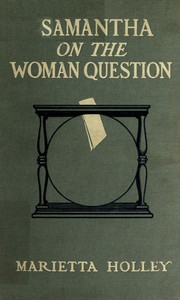
Samantha on the Woman Question — Context and Discussion
15
3
Project Gutenberg
2005
Feminism -- Fiction; Sex role -- Fiction; Women's rights -- Fiction
Readers of public-domain and historical texts
Project Gutenberg digital edition
en
Edition facts
Words: 33,195
Reading time: 145 min
Text sections: 11
Source:
Project Gutenberg record #7833
Marietta Holley's comic novel follows Samantha Allen as she travels to Washington, D.C., encountering debates on women's rights through rustic dialect, biblical arguments, and satirical political figures.
Editorial Edition Score
4.7/5
★★★★★
★★★★★
Calculated from edition completeness, EPUB availability, text structure and catalogue metadata. Not a user rating.
Edition quality
Marietta Holley opens Samantha on the Woman Question with a cascade of practical motives: Samantha Allen agrees to a family reunion near Washington, D.C., partly out of reciprocity, partly to visit her cousin Diantha, but chiefly to attend a suffragist meeting and see the Capitol. The narrator’s voice is established at once—colloquial, wry, and given to homely metaphors like “hit two birds with one stun.” The opening chapter introduces Samantha’s husband Josiah, whose self-regard is gently mocked, and sets up a journey that will expose the couple to competing views on women’s roles. Holley’s humor depends on Samantha’s deadpan observations and the gap between her plain sense and the pretensions around her.
A Voice Thick with Dialect and Irony
Samantha’s narration is the book’s engine. Holley writes in a rustic vernacular—“wuz,” “sez,” “gin her,” “sot store by her”—that signals regional authenticity and comic distance. Samantha herself is no fool; her malapropisms and tangled syntax often sharpen her critique. When she describes the Capitol as “sendin’ out beams of power and wisdom and law and order, and justice and injustice, and money and oratory, and talk and talk,” the repetition undercuts grandiosity. The dialect is consistent, not a mere ornament: it shapes how arguments land. A politician who mistakes “Galatians” for “Gulliver’s Epistle to the Liliputians” is exposed not by Samantha’s erudition but by her plain recall of the Bible. The reader must attend to the rhythm of her speech—its pauses, its sudden leaps—to catch the full weight of her rebuttals.
Biblical Argument as Political Weapon
Holley grounds Samantha’s feminism in scripture, not secular theory. In the excerpted debate, Samantha counters a politician’s claim that men alone are chosen for great undertakings by invoking the Virgin Mary: “the one great theme of the New Testament—the salvation of the world through the birth of Christ—no man had anything to do with.” She argues that God called woman into the work of redemption, and that the “womanly element in our Lord’s nature” makes Christ approachable. This is not a throwaway piety; it is the core of her case. The politician’s ignorance of the Bible—he has “never read further than Gulliver’s Epistle to the Liliputians”—is both a joke and a serious indictment. Holley uses scripture to reclaim authority for women, turning a conservative text into a radical one. Readers should watch how Samantha wields biblical examples (Miriam, Deborah) alongside domestic analogies.
The Comic Pair: Samantha and Josiah
Josiah Allen, Samantha’s husband, is a foil whose complacency generates much of the humor. He agrees to the trip because he is “one of the best lookin’ and influential Allens on earth now,” a boast Samantha reports without comment. Later, he asks of a suffragist, “Does that thing know enough to vote?”—a line that reveals his condescension and his wife’s patience. Holley does not make Josiah a villain; he is a well-meaning but limited man, and Samantha’s affection for him is clear. Their exchanges dramatize the domestic negotiation of the “woman question.” Samantha’s strategy is not confrontation but persistence: she states her views, then lets Josiah’s discomfort speak for itself. The reader is invited to see both sides, but the weight of evidence—and wit—tilts toward Samantha.
Structure: A Journey as Argument
The book’s eleven chapters follow a travelogue pattern: the Allens leave home, visit relatives, attend a suffragist meeting, and tour Washington. Each stop introduces a new interlocutor—a cousin, a politician, a parade of women—who embodies a facet of the debate. Holley uses the journey to vary the setting and the terms of argument. The chapter titles, such as “Concerning Moth-Millers and Minny Fish” and “Old Mom Nater Listenin’,” hint at her method: she yokes the trivial and the cosmic. The suffragist meeting (Chapter IX) and the “Creation Searchin’ Society” (Chapter X) suggest that the book builds toward collective action, but the excerpts do not reveal the ending. Readers should note how Holley balances set-piece debates with domestic scenes, and how the physical movement from home to capital mirrors the expansion of Samantha’s concerns.
Satire of Political Ignorance
Holley’s sharpest satire targets male politicians who oppose women’s rights while knowing little about the Bible or governance. The politician who confuses Gulliver with Galatians is a caricature, but his ignorance is plausible in a world where “the Bible wuzn’t popular” in political circles. Samantha’s patient correction—“That hain’t Bible, there hain’t no Gulliver in it, and you mean Galatians”—exposes the hollow authority of such men. Holley does not need to invent villains; she lets them reveal themselves through their own words. The humor is gentle but pointed, and it invites the reader to share Samantha’s exasperation. This satirical thread runs through the excerpts, suggesting that the book’s target is not just sexism but the broader culture of superficial learning and unearned confidence.
Holley’s novel rewards attention to its verbal texture: the dialect is not a barrier but a key to character and argument. Read the debates aloud to catch the timing of Samantha’s retorts. Note how domestic details—a reunion, a visit, a husband’s grumbling—anchor the political content. The excerpts suggest a work that is both comic and earnest, and that uses humor to make its case without sacrificing conviction. Approach the book as a performance of vernacular intelligence, and let Samantha’s voice guide you.
Reader reflection
What was your reading experience?
Capture what you thought, learned, and would like to remember.
Your progress
0
/
10
2
How much did you enjoy the reading experience?
3
Would you recommend this book to another reader?
4
Did the language feel accessible?
5
How original did the book feel?
6
Could you follow the author’s main argument?
7
What was the strongest part of the book?
8
Would this book work well in a reading group?
9
In one sentence, what did you learn?
10