
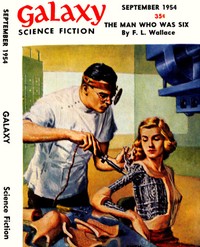
The Man Who Was Six by F. L. Wallace
Let me introduce you to a hidden gem from the early golden age of science fiction: *The Man Who Was Six* by F. L. Wallace. This isn’t your typical “clone in space” story. It rockets straight into your brain with an idea that sounds simple but picks at the core of what makes us us.
The Story
Our narrator is just an ordinary guy—a paleoanthropologist, no less—before his life flips inside out. He spots himself on a video globe 24,000 light-years away, working as some kind of all-powerful therapist. Soon he learns there are actually five other men out there who share his face, his memories, even his birthday. Together, they make one whole person, or so they think. The hitch in this puzzle? Some mysterious, well-funded group is hunting them, for reasons that only become clear at dizzying speed. Our narrator isn't exactly the high-powered version of himself she meets later—think scrappy underdog against massive conspiracy. The plot whips between action-packed escapes, mind-bending conversations with his “sibling” selves, and a climax that ties identity and technology so tight it leaves your head spinning.
Why You Should Read It
Where Wallace really shines is in taking a bewildering situation and making it human. Our main character struggles with jealousy, wonder, and the crushing weight of being just average against his five brilliant echoes. This is what saves the book from being just cool puzzles: it’s grounded in feeling like your life doesn’t measure up—then realizing you might just break the whole societal system meant for you. I devoured the dialogue between the copies. They get real about free will, about desire, about whether to team up or cancel each other out. You got to hand it to Wallace for framing fifty-kart double-think in snackable conversations you can absorb over your coffee table at lunch. Simply put, it treats smart concepts with a playwright’s sense of suspense. And plenty of readers over on secondhand sci-fi forums rave that the language may be older, but the punch would crush half the pulp from our current era.
Final Verdict
The Man Who Was Six is perfect for scouring the cosmos for puzzles that explode with intrigue and social crack. It especially sings to fans of character-driven loops like Leo or reading r/nosleep in 2075. This ain’t the smoothest prose (it’s definitely seen a 1950-era publishing trap) but oh, who cares? I’d hand it over to just about anyone gripped by the unraveling of identity—aliens optional. Treat your shelf. It clocks in as a hidden nuggy that deserves mucho more hearsay. Recommended 9.6/10 read with dark skies coffee.
This work has been identified as being free of known copyright restrictions. You can copy, modify, and distribute it freely.
Jennifer Lee
10 months agoMy first impression was quite positive because the attention to detail regarding the core terminology is flawless. I'll be recommending this to my students and colleagues alike.
Jessica White
2 months agoAs someone working in this industry, I found the insights very accurate.
Michael Rodriguez
2 years agoI wanted to compare this perspective with traditional views, the structural organization allows for quick referencing of key points. Finally, a source that prioritizes accuracy over hype.