
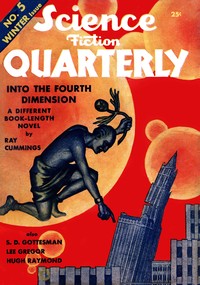
Into the fourth dimension by Ray Cummings
Published in 1923, Ray Cummings's Into the Fourth Dimension is a classic pulp sci-fi adventure that asks a simple, thrilling question: what if we could step outside of our three-dimensional world?
The Story
Dr. Tom Hunter is a brilliant but restless scientist. He's convinced there's more to reality than length, width, and height. Through sheer determination (and some conveniently vague scientific jargon), he builds a device called the 'Dimensional Viewer.' At first, it's a success—he can peer into the fourth dimension! But his triumph is short-lived. He soon discovers he's not just an observer; he's been seen. A powerful, malevolent intelligence from that other realm detects his 'window' and begins trying to force it open from the other side. The book becomes a tense struggle as Hunter, with the help of his friend and a love interest, must find a way to seal the breach before this unimaginable entity fully invades our world.
Why You Should Read It
Don't come to this book for hard science. Come for the sheer, audacious fun of the idea. Cummings writes with a contagious enthusiasm. You can feel his excitement about the concept bleeding through the page. The characters are archetypes—the brave scientist, the loyal friend, the damsel who's surprisingly handy in a crisis—but they serve the story perfectly. What really struck me was the atmosphere. For a book over a century old, it builds a genuine sense of dread around something as abstract as a geometric principle. The 'monster' isn't described in gory detail; its terror comes from its complete otherness, its ability to move in ways we can't even picture. It's a reminder that some of the best scares come from the unknown.
Final Verdict
This book is a perfect pick for fans of sci-fi history and anyone who enjoys a quick, imaginative adventure. It's like finding the blueprint for a hundred later stories. The prose is straightforward and a little clunky by today's standards, but that's part of its charm. If you love modern authors like Blake Crouch who play with physics, you'll appreciate seeing an early ancestor of that tradition. It's not a long or difficult read, but it's a fascinating look at where our genre's big dreams started. Just be prepared for some old-fashioned attitudes alongside the mind-bending concepts.
No rights are reserved for this publication. Access is open to everyone around the world.
Kimberly Thomas
3 months agoThe balance between academic rigor and readability is perfect.
Patricia Williams
10 months agoThe digital formatting makes it very easy to navigate.
Margaret Martinez
7 months agoIt took me a while to process the complex ideas here, but the way the author breaks down the core concepts is remarkably clear. I’ll definitely be revisiting some of these chapters again soon.
Barbara Brown
1 year agoBeautifully written.




John Williams
1 year agoBefore I started my latest project, I read this and the objective evaluation of the pros and cons is very refreshing. I'm genuinely impressed by the quality of this digital edition.